Mel Ah Mu: Finding Light in the Red
By anonymous
This is part of a series of blog posts written by students in an Elon University First Year Writing course. For the course, students wrote profiles of people, places, and events that contribute to LGBTQ+ life in Alamance County.
When Mel Ah Mu talks about Alamance County, she smiles softly before saying, “There’s a lot of really good people here.” Her voice carries the calm assurance of someone who has lived through enough to know that goodness can exist even in complicated places. Her life has been full of strength and persistence. It tells the story of someone who has had to build a sense of belonging wherever she goes.
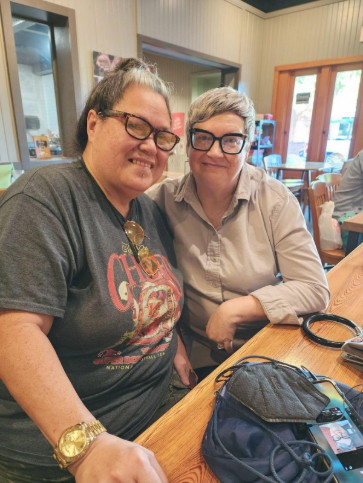
Mel and her partner Lynn
Born in Hamilton, New Zealand, Mel’s childhood stretched across oceans. Her father is Samoan and Chinese, her mother Maori and white. When she was ten, her family moved to O‘ahu, Hawaii, and later to Independence, Missouri. In Missouri, the smallness of the neighborhood and the cruelty of ignorance made her differences and ambiguity a target. She tells me how people in her neighborhood would throw things at her family, shout slurs, and say things like “go back to Africa!”. Her racial identity, already layered and complex, was diluted by the eyes of others who saw only foreignness.
In adulthood, Mel worked as a nurse and caregiver, then ran a business in Kansas City for 22 years, helping undocumented people find homes and manage paperwork. When mentioning the ICE raids, she talked about how much they upset her because “those were the people I would help.”. The memory still seems to live close to the surface.
When she moved to Alamance County in 2005 with her spouse, Dr. Lynn Huber, who teaches at Elon University, Mel found herself navigating a new kind of tension. She describes the area as “kind of diverse, because of Elon,” but adds that the political climate feels harsh. “I think I went through about three Obama signs,” she laughs, remembering how her neighbors stole the signs from her lawn. When she placed a Kamala Harris political sign behind the glass of her front door, someone cut down her baby fig tree instead. “But now we’ve got a flourishing, fertile fig tree,” she says, her tone shifting to something more prideful. In spite of this pushback, Mel found a circle of academic and progressive people who were more accepting. “Whenever I’m with my community here, academic folks and more blue-leaning people, of course, [I feel safe]” she says. “But if I go to the Food Lion over by my house, I need to be careful.” The contrast between her private comfort and public caution reflects something deeper about living queer and brown in the South.
Mel remembers traveling through South Carolina and stopping to use the women’s restroom. “I went in, and this woman got behind me and said, ‘Sir, Sir! You can’t be in here!’” Mel smiles a little at the memory. “Then when they see the front of me, they’re like ‘oh,’ and then they don’t apologize.” Her short hair led others to question her gender, but she no longer seems shaken by their reactions.
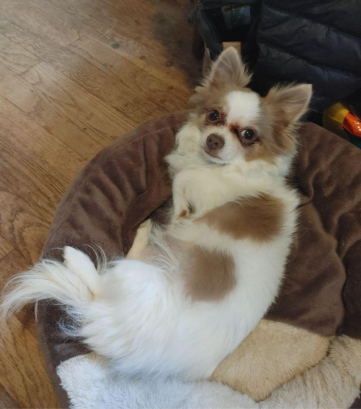
Mel’s dog
She calls herself “old school… gay.” The word lesbian never felt right to her. “I don’t even like the L word. I just identify as gay.” She recalls going to a lesbian club years ago and being hit on by straight men, an experience that made her feel as though the word itself had been taken away from her. The discomfort grew out of years of seeing lesbian identity trivialized, even fetishized. “I’m just gay, I’m a homosexual,” she says firmly, reclaiming the simplicity of a term that has often been complicated by others.
Faith has also been a complicated part of her story. She grew up Mormon, with a father who was a bishop, and says coming out was “horrible.” Her family’s rejection cut deep. “You know you’re not going to see your family in the afterlife,” they told her, a line that still hurts because her sister Crystal died young at 19. After leaving the church, Mel eventually attended a United Church of Christ congregation but left when conflict made the environment toxic. Now her spirituality is more personal. She told me she doesn’t “like organized religion because I feel like it is manufactured fear and control.” Instead, she practices Reiki and believes in “source energy,” a higher power that connects all living things. She tells the story of performing Reiki on her dog, who had painful growths on his neck. The swelling went down, and though he eventually passed away, she believes she helped him find some peace.
Mel’s story is not about overcoming one obstacle or finding a single moment of peace. It is about learning how to keep living in a place that does not always see you clearly and choosing to do so with intention. Her story reminds us that belonging is not something granted by others, but something created through persistence and presence. Even in moments of isolation, she continues to plant things that grow, to connect with those who see her, and to hold space for herself in a place that often overlooks people like her. There is a steady kind of strength in that, a form of resilience that asks for nothing but to exist honestly and fully.