Elon Community Church Welcomes All
By Sabrina Bowen
This is part of a series of blog posts written by students in an Elon University First Year Writing course. For the course, students wrote profiles of people, places, and events that contribute to LGBTQ+ life in Alamance County.
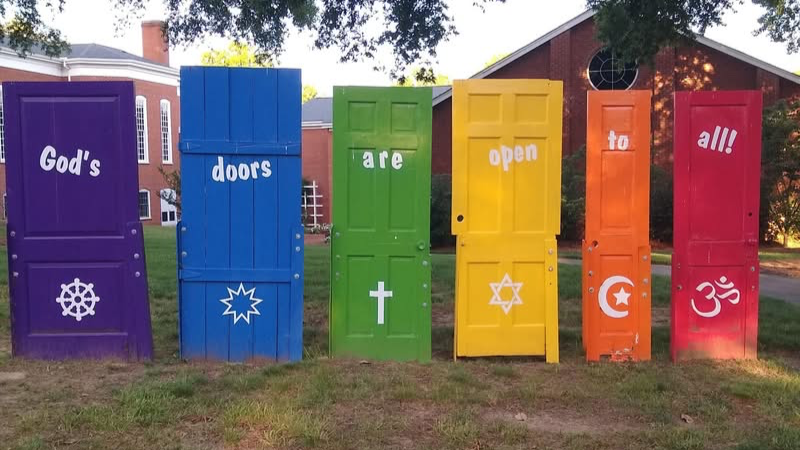
“God’s doors are open to all!” is painted on rainbow doors on the front lawn of Elon Community Church (ECC). The perfect representation of the open and affirming church.
(Credit: Elon Community Church)
Elon Community Church was founded in 1891 and later became affiliated with the United Church of Christ. Its earliest point of acceptance for the denomination was in the 1970s, when the denomination, the United Church of Christ, ordained its first openly gay pastor.
The term open and affirming was created by the United Church of Christ in their Methodist church. So, open and affirming is the name of the denomination that Elon Community Church is a part of. In more recent years, the church has come together to welcome the LGBTQ+ community. According to now retired Pastor Orwig, “as a denomination, [the issue of LGBTQ+ acceptance] has always been an important thing”. In order to be part of this denomination the church had to have a congregational vote in which members of the church vote on issues. This congregational vote didn’t happen until 2012, when they officially became known as an open and affirming church.
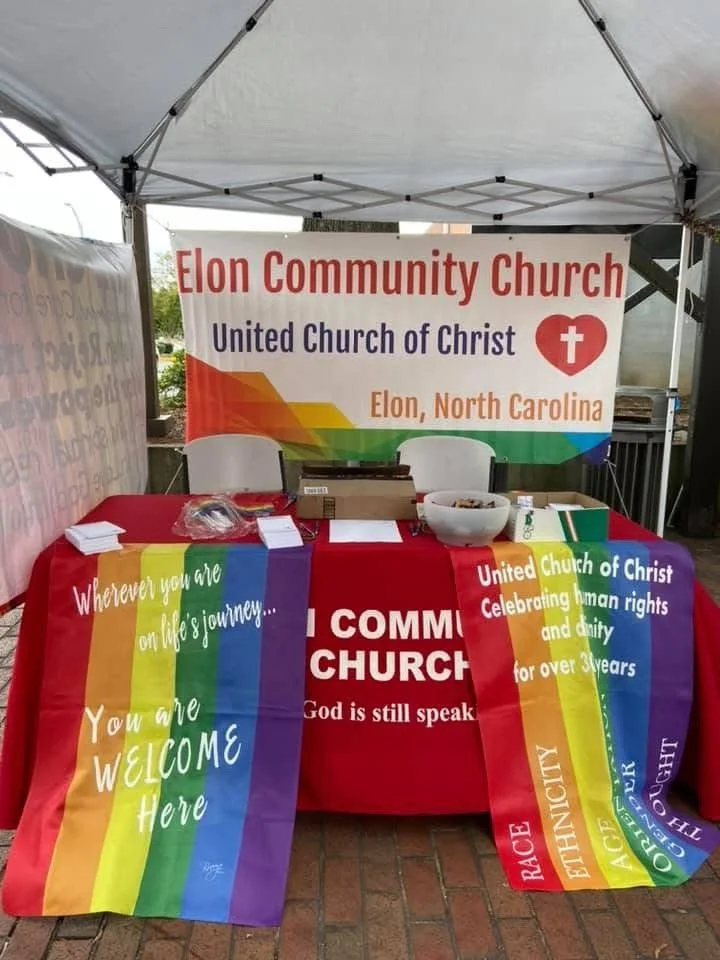
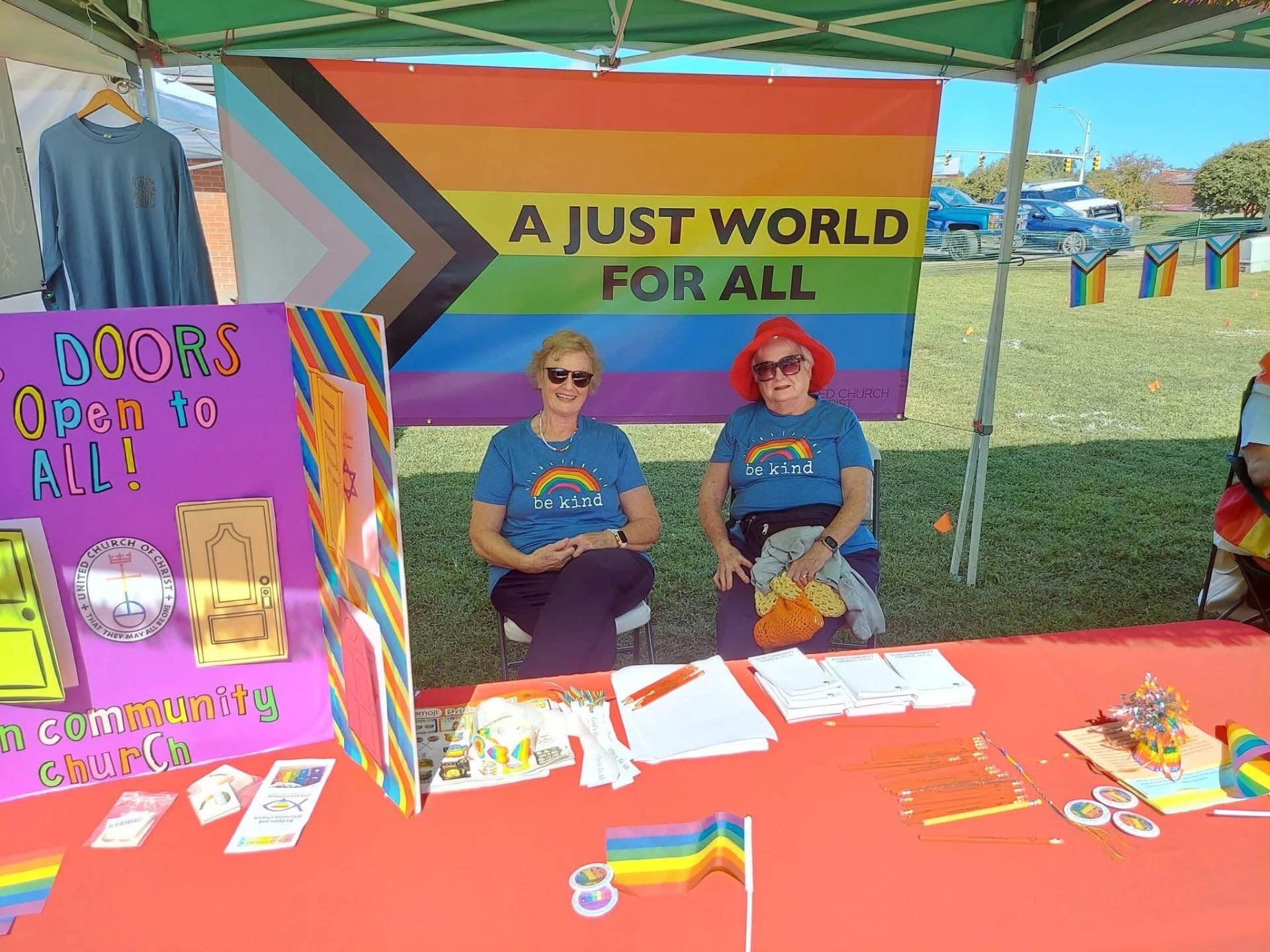
When the church officially became open and affirming, the staff members did some brainstorming. They asked themselves how they could become more welcoming to the community. Some of these ideas included local groups like PFLAG, defending and working with gay straight alliances, purchasing books with LGBTQ+ representation for local high schools, having a booth at Pride in Alamance County, etc.
(Credit: Elon Community Church)
I spoke with now retired Senior Pastor Randy Orwig, who traced the church's LGBTQ+ acceptance back about 27 years to the addition of PFLAG which stands for Parents and Friends of Lesbians and Gays. The PFLAG chapter in Alamance County at Elon Community Church was started by parents who were members of the church that had gay children. The church hosts the PFLAG chapter and its meetings as part of its open and affirming environment. Since it houses this group, the church has brought in many different kinds of people in the LGBTQIA+ community. As a part of the effort to spread awareness, Elon Community Church has helped purchase books for the libraries in local high schools concerning gay friendly issues.
In 2015, a school teacher from Orange County, which is Alamance’s neighboring county to the east, read the book King and King by Linda De Haan and Stern Nijland. King and King is about a prince who needs to get married in order to become King. Many princesses line up hoping to be the one he marries; however, the prince doesn’t show interest in any of them. Finally, the last princess shows up with her brother, who is also a prince, and the prince likes the princess’s brother, so they fall in love, get married, and become kings. The teacher received backlash for reading this book to third graders because some of their parents were concerned that the homosexual theme was inappropriate for the third graders. The school wanted that teacher fired, so the Elon community church came to defend him.
(Credit: Elon Community Church)
The idea for the rainbow doors actually came from an Elon alumnus. ECC went to a gathering of other like-minded churches and advocates for LGBTQ rights. There, they found out about a pastor from Connecticut, who was also an Elon alumnus, who had rainbow doors outside his church. Elon Community Church thought that was a neat idea and recreated the doors. The doors were only going to be up for 4-6 months, but then the pandemic hit, and the church never took them down. However, maybe it is a good thing they were left up because, as pastor Randy Orwig claims, they are “the centerpiece of who we are”. The doors represent the pride the church takes in its inclusivity.
When asked to describe the church’s impact on the LGBTQ+ community in as few words as possible, pastor Randy Orwig said, “It’s mixed. Many people have been hurt by religious entities. But when people come to the church, they have found home”.